
Betts Spring Manufacturing builds custom coil springs from .095” to 1.75” diameter wire, using both cold wound and hot wound processes depending on the size and application. We coil and test every spring in-house, from prototype quantities through high-volume production runs.

Pictured – one of the latest additions to Betts Spring Manufacturing, the Bennett Aquagrind 1200.
Hot Wound vs. Cold Wound: Which Process Fits Your Spring
Wire diameter is the deciding factor. Cold winding forms wire at room temperature around an arbor and covers .095” to .640” diameter wire. Hot winding heats wire to roughly 1,750°F before coiling and covers .500” to 1.75”. Forming thick wire cold risks cracking it or work-hardening it past usable tolerance, so larger springs need the heat.
Full cold wound capability, including compression, extension, and torsion springs and custom coilover springs: cold wound springs. Full hot wound capability, including our furnace process and emissions story: hot wound coil springs.
Materials We Coil
Cold Wound Materials
High tensile chrome silicon (ASTM A401, up to 290 KSI), chrome vanadium (ASTM A231), music wire (ASTM A228), oil-tempered wire (ASTM A229), and stainless grades including 17-7 PH and 302, with 304 and 316 available by request.
Hot Wound Materials
SAE 5160H and SAE 9254. Full sizes and tensile ranges for both processes are on our spring materials page.
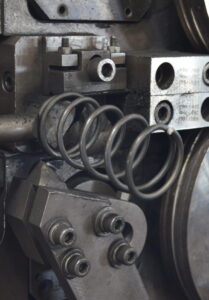
cold wound spring on Herndon Coiler
Custom Coil Spring Capabilities
Engineering and Design
Send us your drawing or your application requirements. Our engineers design springs to your rate, geometry, and load requirements, including single-rate, dual-rate, and multi-rate designs.
Before production starts, our engineers check your design against the loads, lengths, and stress levels it has to hit, and tell you about anything that won’t work together. That way problems get fixed on paper instead of on the production line.
Some springs take load from more than one direction. Those need custom engineering and calculation, so we quote them case by case. Be sure to let our engineering team know in your RFQ.
We can also reverse engineer almost any spring through measurement analysis and physical testing if you’re switching suppliers or replacing a part you can no longer source.
Prototyping and Short Runs
New designs go through dedicated prototyping and first-article production sample testing before scaling to volume manufacturing. We also maintain a short-run prototype department built for quick-turn coiled spring prototypes, small orders, and emergency needs.
Custom Coilover Springs
We build custom coilover springs to your specified rate, free length, and finish for OEM suspension brands, race teams, and performance shops. Spring rate options, materials, and finishing are covered on our cold wound springs page.
Finishing and Secondary Operations
Finishing
In-house heat treatment, deburring, shot peening, and painting. Powder coating through partner companies, with custom colors and finishes on request. Custom logos available.
Secondary Operations
A battery of automatic grinders, including the Bennett Aquagrind 1200, finishes compression springs to exact tolerances for squareness, length, and load. We also handle looping, bending, and forming operations to produce wire forms beyond standard coil springs.
Industries We Serve
Quality, Engineering & Certifications
Certifications
We’re ISO 9001:2015 certified and ITAR registered.
Testing and Documentation
We test finished springs before they ship. Our in-house capabilities also include load testing up to 50,000 pounds, hardness testing, metallurgical analysis, magnetic particle inspection, and 3D CMM verification, applied according to each order’s requirements.
We keep manufacturing date, material heat lot, process parameters, and inspection results on record, and provide material certifications and lot traceability for customers who need that documentation.
Delivery and Ordering
Our hot wound coil line is fully automated and processes over 125 tons of steel a month. We maintain greater than 95% on-time delivery, and our ERP system is EDI-compatible for ordering and invoicing. Full detail: engineering and quality systems.
Frequently Asked Questions
Can Betts handle high-volume, recurring spring orders?
Yes. Our hot wound coil line is fully automated and processes over 125 tons of steel a month, and our CNC cold winding equipment runs the same tooling and quality standards from prototype quantities through full production volumes. We maintain greater than 95% on-time delivery, and our ERP system is EDI-compatible for electronic ordering and invoicing, which makes recurring orders easier to manage on both ends.
We also keep a dedicated short-run department for prototypes, small orders, and urgent needs, so a recurring production program doesn’t compete with a customer who needs a fast turnaround on something small. If you’re planning a long-term or recurring production schedule, bring your volume and timing to our sales team early. It changes how we plan tooling and material on our end
Does Betts manufacture industrial coil springs for heavy-duty mining and construction equipment?
Yes. We manufacture custom compression springs for the mining and construction industries, among others, using automatic coiling equipment that handles .095 inch to 1.75 inch diameter wire across cold and hot wound processes.
In mining, we’ve designed and manufactured springs for shakers, cranes, loaders, and other mining and vibratory equipment, where rugged conditions put excessive wear on both the equipment and the springs inside it.
In construction, we’ve supplied leaf and coil springs for heavy-duty equipment, trucks, and other on-site construction machinery. Every spring goes through the same in-house heat treatment, shot peening, and finishing process regardless of industry, because mining and construction environments don’t leave room for a spring engineered to a lower standard.
What’s the difference between hot wound and cold wound coil springs?
Cold winding forms wire at room temperature and covers .095” to .640” diameter wire. Hot winding heats wire to roughly 1,750°F before coiling and covers .500” to 1.75”. Wire diameter and the mechanical stress of forming it determine which process we use.
What wire diameter range can Betts coil?
From .095” to 1.75” diameter wire, combining our cold wound and hot wound capability.
Can you build a prototype or small-quantity order?
Yes. We maintain a short-run prototype department built for quick-turn coiled spring prototypes, small orders, and emergency needs.
What quality certifications does Betts Spring hold?
ISO 9001:2015 certified and ITAR registered. In-house quality capabilities include load testing, hardness testing, metallurgical analysis, magnetic particle inspection, and 3D CMM verification, applied according to each order’s requirements.
Do you build custom coilover springs?
Yes. We build custom coilover springs to your specified rate, free length, and finish for OEM suspension brands, race teams, and performance shops, from low-quantity runs up through high-volume orders. See our cold wound springs page for spring rate options, materials, and finishing.
What information do you need to quote a custom coil spring?
Send the current drawing revision, quantities, and delivery requirements. The drawing should define free length, inside or outside diameter, end configuration, load points, and tolerances, along with any specified material or finish.
If the design is still in development, include the installation envelope, working lengths, and required load range. Flag any dimensions or performance requirements that are still open. That gives us a clearer starting point than a nominal spring rate alone.
Which dimensions are critical when fitting a coil spring into an assembly?
Start with inside or outside diameter, free length, end geometry, and seat dimensions. Then check the spring through its full working stroke, from its longest installed length to maximum compression.
Your interface drawing should establish clearance to any rod, bore, or adjacent hardware, retention at full extension, and the allowable compressed length. Specify the required margin to solid height so nobody has to guess at it. Include drawings of the seats and mating parts where available, because a part number alone may not define every interface.