
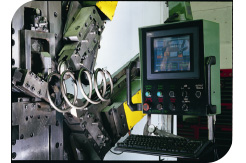
Cold Wound Compression, Extension & Torsion Springs
We cold wind springs by feeding wire through rollers and fulcrum pins, forming it around an arbor. We manufacture a variety of compression, extension, and torsion springs to suit your application, including custom coilover springs built to your specified rate, free length, and finish for OEM suspension brands, race teams, and performance shops.
A Legacy of Spring Manufacturing Since 1868
We’ve manufactured custom springs since 1868, when the company was founded in San Francisco, and we remain the oldest spring manufacturer west of the Mississippi River. Betts Spring Manufacturing is a division of Betts Company, still family-owned after six generations, with cold and hot wound spring production based in Fresno, California today.
That experience carries directly into our cold wound spring work. We supply custom springs to OEMs, including customers in oil and gas and military applications.
We manufacture private label springs to your specifications. Custom logo imprinting and custom boxing or packaging are available as options, or we can ship your springs unbranded for you to assemble into your own products or suspension kits.
Cold Wound Spring Manufacturing Capabilities
Spring Types We Cold Wind
- Compression springs resist a pushing load and store energy as they shorten.
- Extension springs resist a pulling load and store energy as they stretch.
- Torsion springs resist a twisting load around their axis.
The Cold Coiling Process
Wire feeds through rollers and fulcrum pins and wraps around an arbor to form each coil.
Coiling Equipment
Three CNC spring coilers ranging from .250” to .640” wire diameter, and two CNC spring coilers ranging from .095” to .500” wire diameter. Combined, that covers the full .095” to .640” cold wound range, with two different machine setups able to handle the .250” to .500” band depending on the job.
Need Heavier Wire?
Our cold wound range tops out at .640” wire. For larger, heavier springs, we build hot wound coil springs on our fully automated hot wound line. Not sure which process fits your spring? Our coil springs overview compares the two.
Grinding
Four CNC horizontal infeed precision spring grinders, two 30” down-feed grinders, and one CNC wet grinder.
Industries and Applications
We build cold wound springs for a wide range of equipment. Here’s how that breaks down by industry.
Automotive
We supply OEM automotive programs and the aftermarket, including springs for lifting, lowering, and racing applications. For suspension brands, race teams, and performance shops, we build custom coilover springs to your specified rate, free length, and finish, from low-quantity production runs up through high-volume orders.
Trucking
Trucks and trailers put springs through constant vibration, road shock, and weather. We build extension springs for brake shoe return and pedal return, compression springs for fifth-wheel locks, latches, and seat suspension, and torsion springs for hood assist, trailer doors, and ramps. Heavy wire and high tensile chrome silicon help those springs hold their load across hundreds of thousands of miles.
Industrial
Machinery runs on springs. We build compression springs for valves, pumps, clutches, and presses, extension springs for tensioning and return mechanisms on doors, guards, and access panels, and torsion springs for hinges, latches, and counterbalance assemblies. When a spring has to survive millions of cycles on a production line, rate consistency across the whole order matters as much as the design itself.
Construction
Construction equipment works in dust, mud, and constant shock loading. We build compression springs for quick couplers, attachment latches, and operator seat suspension, extension springs for pedal and control return, and torsion springs for hood, access door, and cab door counterbalance. We coil to your drawing and hold the rate across the full production run.
Mining
Mining equipment runs hard and runs long. We build compression springs for vibrating screens, feeders, and conveyor belt cleaner tensioners, extension springs for return and tensioning mechanisms, and torsion springs for belt scraper tensioners and hinged guards. When a spring failure means downtime underground or at the plant, fatigue life is the spec that matters most.
Entertainment
Stage machinery, rigging systems, amusement rides, and animatronics all rely on springs that perform the same way show after show. We build compression springs for lifts and shock absorption, extension springs for tensioning and return motion, and torsion springs for counterbalanced doors, panels, and pivoting set pieces. Tell us the duty cycle and the load, and we’ll design to it.
Food Processing
Conveyors, filling and packaging lines, slicers, and mixers use compression, extension, and torsion springs in tensioners, return mechanisms, and hinged guards. Washdown and moisture are the main enemy here. For corrosion resistance, we cold wind SAE 302 and 17-7 PH stainless, with 304 and 316 available by request.
Farming and Agriculture
Farm equipment takes a beating in the field. We build compression springs for tillage shanks, planter down-pressure, and seat suspension, extension springs for balers, mower decks, and implement return, and torsion springs for gates, hitches, and folding components. Heavy wire and high tensile materials help springs hold their load through a full season of shock loading.
Oil and Gas, Military, and Medical
We also build cold wound springs for oil and gas and military customers, and for medical applications. We’re ITAR registered for defense work.
Spring Design and Engineering
Spring Rate Options
We build single-rate, dual-rate, and multi-rate springs. A single-rate spring holds one constant rate through its travel.
How We Work From Your Design
Send us your drawing or your application requirements. Before production starts, our engineers check your design against the loads, lengths, and stress levels it has to hit, and tell you about anything that won’t work together. From there, they calculate wire diameter, coil count, and free length through stress analysis and material selection.
Multi-Directional Loads
Some springs take load from more than one direction. Those need custom engineering and calculation, so we quote them case by case. Please note this in your RFQ and our team will review it.
Reverse Engineering
If you’re switching suppliers or replacing a spring you can no longer source, our team can reverse engineer almost any spring through measurement analysis and physical testing. Send a working sample or a broken part, and we’ll get you back to spec.
Prototyping and First Article
New designs go through dedicated design, prototyping, and first-article production sample testing before they move to volume manufacturing. We test finished springs before they ship. See our quality systems page for testing details.
Materials and Wire Sizes
High tensile chrome silicon is the material we cold wind most often, and the most common choice for coilover springs. What high tensile buys you is resistance to set and load loss at high design stress, plus fatigue life.
| Material | Size Range | Tensile Strength* |
| ASTM A401 High Tensile Chrome Silicon | .189” to .640” | up to 290 KSI |
| ASTM A401 Commercial Chrome Silicon | .112” to .625” | 220 to 275 KSI |
| ASTM A231 Chrome Vanadium | .128” to .281” | up to 260 KSI |
| ASTM A228 Music Wire | .098” to .280” | 230 to 272 KSI |
| ASTM A229 Oil Tempered Class 2 | .148” to .625” | up to 270 KSI |
| 17-7 PH Stainless Steel (Condition C) | .125” to .562” | up to 300 KSI |
| SAE 302 Stainless Steel | .125” to .562” | up to 240 KSI |
| SAE 304 / 316 Stainless Steel | available by request | varies by grade |
*Tensile strength depends on wire diameter.
We also stock chrome vanadium, music wire, oil-tempered wire, and several stainless grades. SAE 304 and 316 stainless are available by request.
Finishing
Shot Peening
We offer shot peening. It puts the wire surface into compression, which extends fatigue life under repeated loading. Ask for it in your RFQ if your application sees high cycle counts.
Powder Coating and Custom Colors
We powder coat through partner companies. Custom colors and finishes are available on request. Include your color and branding requirements when you submit your RFQ, and we’ll quote to your spec.
Corrosion Testing and Compliance
We finish springs to meet industry compliance and salt spray testing standards.
Quality Control
Our in-house capabilities include load testing up to 50,000 pounds, hardness testing, metallurgical analysis, magnetic particle inspection, and 3D CMM verification. We don’t run every test on every spring, so ask your sales contact which inspections apply to your order.
We’re ISO 9001:2015 certified and ITAR registered, and we maintain greater than 95% on-time delivery.
Who We Work With
We build custom springs for OEMs, companies that produce their own custom suspension kits, and a wide range of other businesses that need springs built to spec, from low-quantity production runs up through high-volume orders. We don’t sell single replacement springs to individual vehicle owners.
If you’re building a product and need a manufacturing partner who can hold a rate and a finish across a production run, contact our sales team to discuss your application.
Frequently Asked Questions
What types of springs does Betts cold wind?
We cold wind compression, extension, and torsion springs in wire diameters from .095” to .640”.
Does Betts use high-tensile strength wire in cold wound springs?
Yes, where the application calls for it. Contact us for a list of high-tensile wire options for your spring.
Can Betts build dual-rate or multi-rate springs?
Yes. We build single-rate, dual-rate, and multi-rate springs, calculated from the requirements in your design.
What material is best for coilover springs?
High tensile chrome silicon, in sizes from .189” to .640” with tensile strength up to 290 KSI. It resists set and load loss at high design stress and holds up well in fatigue.
Should we specify spring rate or loads at installed lengths?
Specify loads at defined lengths, such as installed length and maximum working compression, as your acceptance criteria, along with the nominal rate and its tolerance. For a dual-rate or multi-rate spring, give enough load points to describe the full curve.
What operating data should we provide for a fatigue-critical spring?
Give us the minimum and maximum working loads or lengths, duty cycle, service-life target, any overload events, and temperature and environmental exposure.
What should an OEM include in a production RFQ?
Include the released drawing and revision, annual volume, order quantities, launch schedule, and any certification, traceability, inspection, or packaging requirements. Mark which requirements are fixed by the design and which allow alternatives.
Can you reproduce a spring from a sample we already have?
Yes. Send a working sample or a broken part, and we’ll reverse engineer it through measurement analysis and physical testing.
Do you support prototype or first-article runs before a full production order?
Yes. New designs go through prototyping and first-article sample testing before volume manufacturing.
Can Betts handle large quantity orders of precision cold wound springs?
Yes, we regularly handle large quantity orders for cold wound springs for our customers. In addition to large orders, be sure to ask us about warehousing your springs at our Fresno warehouse, where our team can ship quantities to you as needed or as scheduled. We also offer custom logo imprinting and boxing or packaging.